Your Television Is Watching. The Lawsuits Are About Where That Data Goes
Smart TVs fingerprint what you watch and sell it. Two makers settled with Texas; the China-linked ones are fighting. Inside the ACR wave and the VPPA question.
Smart-TV ACR Surveillance Lawsuits and the Data-to-China Question
Somewhere in the setup menu of the television in the living room, a feature almost no one turns off is quietly doing the most consequential thing the set does.
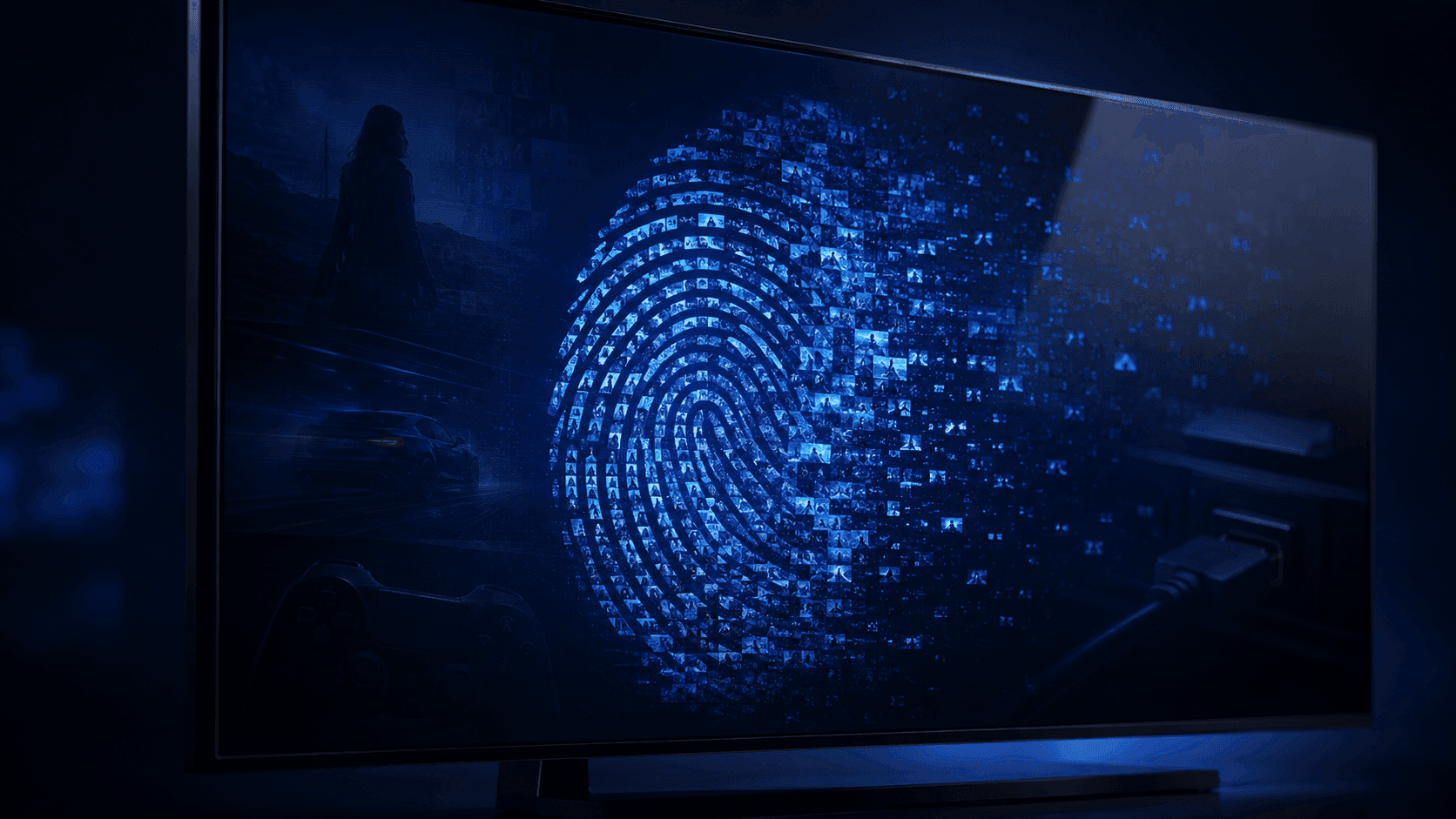
Every fraction of a second, one complaint alleges as often as every 500 milliseconds, the software takes a snapshot of whatever is on screen, fingerprints the image and audio, and matches it against a database to work out exactly what the household is watching. Cable, a streaming app, a game console, a disc, anything routed through an HDMI port, all of it is legible to the set.
The technology is called Automatic Content Recognition, and the lawsuits say the resulting record of a family's viewing life is packaged with persistent identifiers and sold.
That much is an ordinary privacy grievance, and it would be a modest one if the story ended at advertising. It does not. For a subset of the manufacturers now being sued, the plaintiffs allege the viewing data does not merely reach ad-tech brokers; it reaches companies bound by Chinese law that can be compelled to hand it to the state.
That single allegation is what has turned a familiar ad-tech complaint into something regulators treat as a security matter, and it is already visible in who is settling and who is not.
A practice the government flagged in 2017
None of the underlying conduct is new. In February 2017 the Federal Trade Commission and New Jersey settled with the television maker Vizio for $2.2 million over precisely this: ACR software that, by default, captured second-by-second viewing data from roughly 11 million sets and sold it without meaningful consent.
The FTC treated a person's television history as sensitive information requiring clear notice and opt-in permission, and the order made Vizio delete data and disclose the practice. Industry lawyers read it as a warning to every set maker.
The current complaints allege the warning was ignored and the data business only grew; one alleges its defendant made more money selling viewer data than selling televisions.
An old videotape law, aimed at a new box
The legal weapon is a statute written for the Reagan era. The Video Privacy Protection Act of 1988, passed after a newspaper obtained a Supreme Court nominee's video-rental history, bars a “video tape service provider” from disclosing what a person watches and sets liquidated damages at $2,500 per violation, the number that makes it a class-action engine.
The theory is that a smart-TV maker running ACR is a modern video tape service provider handing viewing histories to third parties without the written consent the law requires.
Around that federal core the complaints stack the federal Wiretap Act, California's Invasion of Privacy Act, its computer-fraud statute, unfair-competition and unjust-enrichment counts, and a California constitutional privacy claim.
Three private class actions frame the field. Samsung (Southern District of New York, January 2026) is the clean version, Samsung's ACR and the vendor Samba TV, pleaded on privacy grounds with no geopolitics.
TCL and Hisense both Northern District of California, May 2026) run the same privacy claims but add the national-security frame, and they share a named plaintiff, a sign of a coordinated campaign rather than scattered filings. The Hisense case centers on the company's wholly-owned operating-system and ACR subsidiary, VIDAA.
How it unfolded
Feb 2017 The FTC and New Jersey settle with Vizio over ACR on some 11 million televisions.
Dec 2025 Texas sues Sony, Samsung, LG, Hisense, and TCL under the state's Deceptive Trade Practices Act, and wins restraining orders against Hisense and Samsung.
Jan 2026 The first private class action lands against Samsung in New York, and the Supreme Court agrees to decide who counts as a “consumer” under the VPPA.
Feb 2026 Samsung settles with Texas, agreeing to collect ACR data only with express consent.
May 2026 LG settles with Texas, and its deal bars transfers of viewing data to the Chinese Communist Party. Private suits are filed against TCL and Hisense in California.
Aug 2026 Firms announcing investigations into tracking on Sony BRAVIA sets.
Oct 2026 The Supreme Court's new term opens with the VPPA “consumer” question set for argument.
Where the five defendants stand
The Texas attorney general sued all five of the largest television brands at once. Watching who has folded and who has dug in is the fastest read on where the real exposure sits.
Settled with Texas, and not alleged to be tied to the Chinese state:
Samsung (South Korea): settled February 2026 after a restraining order, agreeing to collect ACR data only with express consent. Separately sued in (S.D.N.Y.).
LG (South Korea): settled May 2026, in a deal that bars transfers of viewing data to the Chinese Communist Party. No private class action yet.
Still contesting:
Sony (Japan): the attorney general called its tracking extreme and continuous. Targeted through the Samba TV suit (2025) and investigations into BRAVIA sets.
Hisense (China, alleged state-owned): under a December 2025 restraining order. Sued in (N.D. Cal.).
TCL (China, alleged state-linked): sued in (N.D. Cal.).
The fight splits along one line
Look at the settlement column and a pattern jumps out. The two makers that have resolved the Texas case, Samsung and LG, are the two with no alleged tie to the Chinese state.
The three still fighting include both defendants the complaints describe as Chinese-controlled: Hisense, pleaded as a state-owned enterprise majority-controlled by a municipal government in China, and TCL, pleaded as the domestic arm of a state-linked group.
That is not a coincidence of litigation strategy so much as a measure of what each defendant is actually being accused of.
For a Korean manufacturer, the charge is that it collected viewing data without adequate consent, a problem that a better disclosure screen and an opt-out can largely fix, which is roughly what the Texas settlements require.
For a manufacturer the complaints tie to Beijing, the charge is different in kind: that a continuous record of what millions of American households watch sits within reach of a foreign government. There is no consent screen that cures that.
The tell is in LG's settlement, which went out of its way to prohibit transfers of viewing data to the Chinese Communist Party even though LG is Korean.
When a remedy against a Korean company is written around China, the center of gravity of the whole enforcement effort is not hard to locate.
Strip away the ad-tech vocabulary and the cases reduce to one question: once your television knows what you watch, whose hands does that knowledge end up in?
The defenses, and the question hanging over all of it
None of this is a sure thing, and a careful reader should weigh the other side.
The central defense is definitional: is a television manufacturer a “video tape service provider” at all, a phrase written for a 1988 rental counter, and is an ACR fingerprint “personally identifiable information” tied to a person rather than a device?
Manufacturers will argue that setup-screen disclosures and default settings amount to consent and that much of the data is de-identified. These are serious arguments, and they are why the cases against the remaining defendants are being contested rather than quietly resolved.
The largest uncertainty is at the Supreme Court. In January 2026 the Court took up Salazar v. Paramount Global to decide who qualifies as a “consumer” under the VPPA, with argument set for the term that opens in October 2026 and a decision expected in 2027.
A ruling that narrows the definition would not end the smart-TV suits, which plead wiretap and state-law claims in the alternative, but it would reshape their most valuable count.
The state enforcement track, by contrast, does not depend on the VPPA at all: Texas is proceeding under its consumer-protection statute, and its restraining orders and factual findings give private plaintiffs a running start regardless of what the Court does.
Two structural facts point to where this goes next. One is a vendor: Samba TV, whose ACR software sits inside sets from several brands, is a potential choke point and already a direct target, sued in 2025 over the interception of Sony BRAVIA viewing histories and now the subject of a fresh investigation into Sony sets.
The other is a pattern of expansion: Sony and LG were named by Texas but have not yet drawn the private class actions the other brands have, and the operating-system layers beneath many televisions remain largely untested. The regulatory spotlight on ACR suggests more states will follow Texas rather than wait for it.
The through-line is not really about televisions. It is about a decade-old surveillance practice finally meeting a response, and about the fact that the same conduct is treated very differently depending on where the data ends up. A privacy lapse gets a consent screen and a settlement.
An alleged pipeline to a foreign government gets a fight. The most exposed defendants in this wave are not the ones with the most viewers. They are the ones whose data, the complaints say, does not stay in the country, and that is the line the settlements are already tracing.
Track the smart-TV surveillance wave as it spreads.
Every filed ACR case, the brands and vendors named, the jurisdictions and statutes in play, and the rulings shaping the VPPA theory, tracked in one place and updated as the docket moves.
Originating or defending in this space? Rain maps emerging theories to the companies, vendors, and forums most exposed before the next complaint is filed. Book a 30-minute walkthrough.