How Price Parity Clauses Became the Common Thread in Antitrust Cases Against Amazon, Steam, and Now Microsoft
One contract clause now sits at the center of antitrust cases against Amazon, Steam, and Microsoft. Here's why price-parity provisions (MFN clauses) became a billion-dollar liability, and where the theory is still untested.
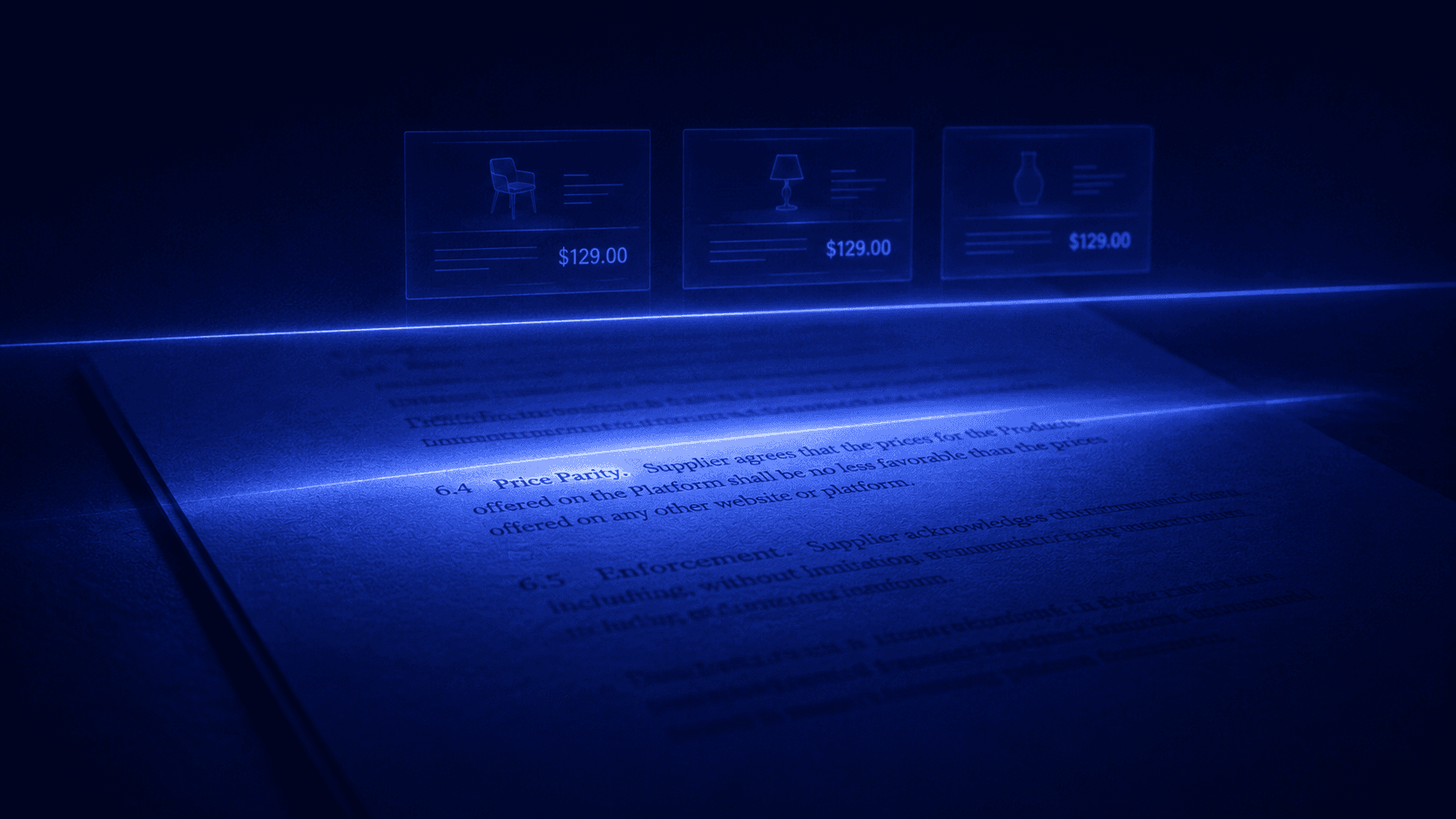
On May 31, 2026, two PC gamers sued Microsoft in the Western District of Washington, alleging that a clause in its 2011 distribution contract with Valve (the company behind the Steam storefront) kept the price of Microsoft-published games artificially high for fifteen years.
The complaint, Rockman v. Microsoft, is striking on its own terms. But it is most useful as a marker of where platform antitrust is heading, because it shares a single piece of contractual DNA with the largest consumer antitrust cases in the country: the price-parity clause.
Strip away the gaming-industry detail and the same provision sits at the center of cases against Amazon, against Steam, and now against Microsoft. Understanding that clause, what it does, why enforcers have turned on it, and where the theory is still untested, is the key to reading all three.
The clause at the center of it all
A price-parity clause, often called a platform most-favored-nation (PMFN) provision, is deceptively simple. It requires a seller that lists a product on one platform to charge no more there than it charges anywhere else.
In isolation, that sounds pro-consumer, who objects to a promise of the lowest price?
The antitrust concern, which the American Bar Association's antitrust section has explored at length, is the opposite of intuitive: by guaranteeing that a seller cannot undercut a dominant platform elsewhere, a PMFN can remove the seller's incentive to offer discounts on rival platforms at all.
The floor that protects the big platform becomes a ceiling on competition. A platform charging a high commission has little to fear from a cheaper rival if no seller can pass the rival's savings on to shoppers.
Three platforms, one theory
The PMFN theory is no longer novel. It is becoming the organizing principle of modern platform antitrust enforcement, and the procedural milestones are stacking up. In the Amazon litigation, the FTC and seventeen states allege that Amazon's anti-discounting policies function as a PMFN that props up an artificial price floor across e-commerce.
A parallel consumer class action, De Coster v. Amazon, reached a remarkable milestone in 2025 when a federal judge certified a class of roughly 288 million consumers (described as the largest in U.S. history) after finding that Amazon's practices function as a PMFN policy.
The same clause drives the Steam litigation. In Wolfire Games v. Valve (consolidated as In re Valve Antitrust Litigation), game developers allege that Valve's parity requirement forces publishers to hold prices identical across storefronts, insulating Steam's 30% commission from competition.
A federal court certified a class of roughly 32,000 developers in late 2024, with class-wide overcharges estimated in the billions.
As legal scholars analyzing the case have noted, the dispute turns on whether a parity clause imposed by a dominant platform is a legitimate quality-control tool or an instrument of price coordination.
What makes the Microsoft case different
Against that backdrop, Rockman is not simply a third entry in the same series. It makes a more aggressive legal move.
The Amazon and Steam cases largely attack PMFNs as vertical restraints (a platform imposing parity on the sellers beneath it) which are judged under the fact-intensive rule of reason, requiring proof of market power and net competitive harm.
The Microsoft complaint instead characterizes the 2011 parity clause as a horizontal agreement between two would-be competitors (Microsoft's storefront and Steam) and therefore as per se illegal price-fixing, a category that, if it applies, skips the market analysis almost entirely.
That distinction is the whole case. Per se treatment is the most dangerous posture in antitrust for a defendant, and it is also the hardest for a plaintiff to earn. What makes the complaint unusual is the evidence it marshals toward that characterization.
Most Sherman Act §1 conspiracy claims fail at the pleading stage because the plaintiff cannot show an actual agreement.
Here the plaintiffs point to the contract itself, the specific provision (Section 6.4(b)), and Microsoft's own internal communications, which allegedly describe the arrangement in the platform's own words, that once a title released on Steam, the company “needed to give Steam price parity” across its other digital channels.
They also invoke a finding from a separate arbitration, discussed below. (The complaint additionally alleges that Microsoft received “kickbacks” from Valve for not competing; that allegation is pleaded on information and belief and remains unproven.)
Why it is not a slam dunk
For all its evidentiary heft, the complaint faces real obstacles, and they cut to the same horizontal-versus-vertical question. The arbitral finding the plaintiffs lean on, that an arbitrator in a separate proceeding (Valve v. Abbruzzese) concluded the clause was an unlawful horizontal price-fixing agreement, is not what it might first appear.
It arose in private mass arbitration against Valve, Valve is seeking to vacate it, and no federal court has adopted it. As persuasive material it is useful to the plaintiffs; as precedent it binds no one.
More fundamentally, Microsoft and Valve can be expected to argue that the clause is vertical, not horizontal, that it governed only how Microsoft priced its own games across channels, a distribution term rather than an agreement between competitors to fix a market price.
If a court accepts that framing, the per se theory collapses into a rule-of-reason analysis, and the case becomes a far heavier lift requiring detailed proof of market definition and anticompetitive effect.
The same parity clause can look like coordination or like ordinary contracting depending on the lens, and which lens applies is exactly what the motion to dismiss will contest.
It is also worth remembering that nothing has been tested: the complaint was filed days ago, and Microsoft has not yet responded.
Why it matters
For any business that operates a platform or sells across several of them, the through-line is the practical lesson.
Parity provisions that were once treated as routine commercial housekeeping are now the single most scrutinized clause in platform antitrust, and the scrutiny is arriving from every direction at once, federal enforcers, state attorneys general, developer classes, and consumer classes.
A clause that produces uniform pricing is now a litigation magnet regardless of how it is labeled in the contract.
For the broader antitrust bar, the cluster of cases is a live experiment in how far the PMFN theory can stretch. The Amazon and Steam cases will test it under the rule of reason at scale; Rockman tests whether the same clause can be recast as per se horizontal conduct when two platform operators sit on both sides of it.
If that recharacterization succeeds even at the pleading stage, it lowers the evidentiary bar for a wave of follow-on suits against any pair of competitors whose contracts contain parity language.
If it fails, it will clarify the boundary between a vertical distribution term and a horizontal conspiracy, a line that platform commerce has been blurring for a decade. Either way, the parity clause has become the place where platform antitrust is being decided.
Know which clause is the next litigation magnet.
Price-parity clauses went from boilerplate to billion-dollar exposure across Amazon, Steam, and Microsoft before most companies revisited their contracts.
Rain Intelligence tracks emerging antitrust theories and maps them to the agreements, industries, and parties most exposed.
Book a demo to see what’s forming in your sector now.