The Courthouse Backstop: Data-Center Water Pollution and Amazon's $20.5M Nitrate Settlement
Amazon's $20.5M nitrate deal is the first Big Tech data-center water settlement, and a template. Why data center litigation is replacing regulation, and who's exposed next.
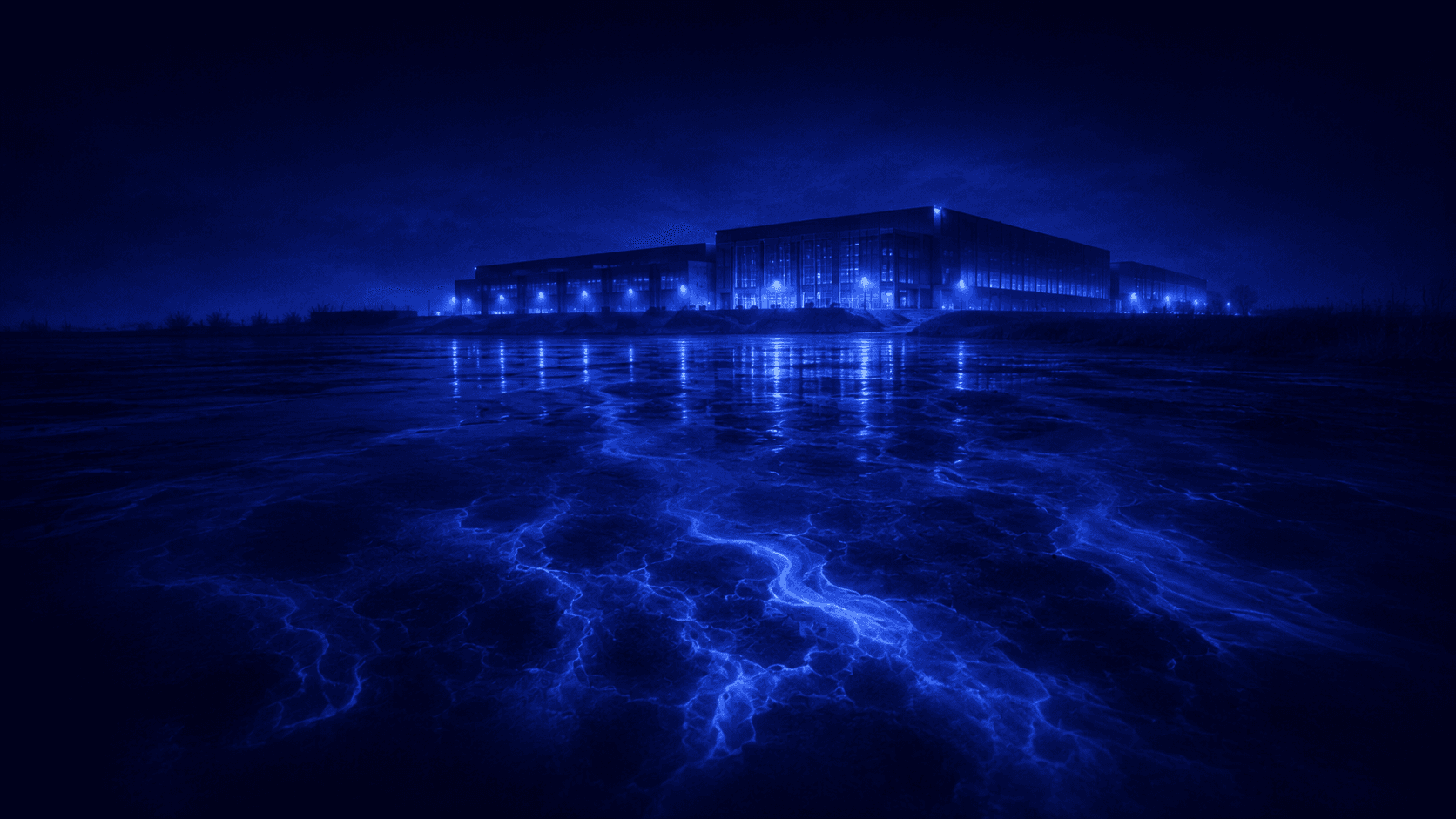
On March 31, 2026, Amazon agreed to pay $20.5 million to resolve claims that its Oregon data centers contributed to nitrate contamination of the groundwater beneath Morrow and Umatilla counties. Amazon denied wrongdoing, and the deal still awaits court approval.
The figure is modest by class-action standards. Its significance lies in the timing: it is, by most accounts, the first time a major technology company has agreed to pay damages tied to a public-health harm allegedly worsened by its data centers, and it lands at the exact moment the political ground beneath the industry is shifting.
Three forces are converging. Washington is racing to accelerate data-center permitting. Federal environmental enforcement is falling to lows not seen in decades. And a bipartisan revolt against the water and power demands of the AI build-out is spreading through statehouses and town halls.
Together they are pushing the fight over data centers' environmental footprint out of the agencies and into the courthouse, which is why the Oregon settlement reads less like an endpoint than a template.
The “concentrator” theory, explained
The legal theory at the center of the case is novel enough to merit a careful description, because the whole dispute turns on it.
Many large data centers sit in agricultural regions where groundwater is already stressed by decades of fertilizer runoff, water that can carry nitrate near or above the federal drinking-water limit of 10 milligrams per liter. To cool their servers, these facilities run that water through massive evaporative cooling towers. Pure water leaves as vapor; the dissolved nitrate does not. It stays behind and grows more concentrated with each cycle.
Plaintiffs argue this process effectively distills the pollution: a facility might draw water that is already marginally unsafe and discharge a far more concentrated waste stream.
On that theory, the data center is not a passive water user but a supercharger of an existing hazard, which can, plaintiffs contend, trigger liability under the federal Resource Conservation and Recovery Act (RCRA), the statute governing handling and disposal of solid and hazardous waste, alongside common-law negligence, nuisance, and trespass.
What actually happened in Morrow County
The litigation, led by Hagens Berman with co-counsel Bliven Law Firm and Heenan & Cook, grew out of a long-documented public-health emergency. The Oregon Health Authority has identified more than 600 domestic wells in the Lower Umatilla Basin Groundwater Management Area with unsafe nitrate levels, some many times the federal limit, across a 562-square-mile area home to roughly 45,000 residents.
Plaintiffs allege that Amazon, which has operated data centers in the county since 2011, sent concentrated wastewater to disposal systems run by the Port of Morrow that had repeatedly exceeded their permit limits, compounding the contamination reaching residential and public wells.
Amazon was one of numerous defendants in the broader action, and its $20.5 million settlement resolves only its portion; the litigation continues against the Port of Morrow, food processor Lamb Weston, and several large agricultural operations.
The fund is earmarked for private-well and public water-infrastructure projects across the basin rather than distributed as conventional damages.
The regulatory vacuum that litigation is rushing to fill
To see why the settlement matters beyond Oregon, look at what the federal government is doing (and not doing) at the same moment. In 2025 the administration issued Executive Order 14318, “Accelerating Federal Permitting of Data Center Infrastructure,” which streamlines environmental review for large facilities and their power supply. The clear federal signal is speed: build more compute, faster.
Running alongside that build-out is a sharp retreat in enforcement. By early 2026, EPA inspections under RCRA had fallen to among the lowest levels in twenty years, and Administrator Lee Zeldin announced a sweeping deregulatory agenda that hands more authority to states.
When public enforcement recedes, the statutory gap does not vanish, it shifts to private hands. RCRA was written with exactly this backstop in mind: its citizen-suit provision lets affected residents sue to abate an “imminent and substantial endangerment” when regulators do not. The Oregon case rode that provision to a recovery. In an enforcement vacuum, the citizen suit stops being a supplement and becomes the main event.
Two reasons the theory is not a sure thing
Defense counsel have a strong response, and it comes in two parts. The first is that the Oregon settlement settled remarkably little as a matter of law. No court has squarely decided whether cooling-tower blowdown from a data center is solid waste under RCRA, or whether an operator can be a waste generator merely for concentrating contaminants that originated elsewhere.
A magistrate judge in Oregon let the claims proceed past a motion to dismiss, but the case was stayed pending settlement before any merits ruling. Amazon's exit leaves the generator question unresolved, and the plaintiffs' own multi-source framing (that Amazon was one contributor within a contamination network of agriculture, wastewater disposal, and regional infrastructure) invites every defendant to point at someone else and demand isotope-level proof of its individual share.
The second is procedural, and it cuts directly against the citizen-suit strategy. In February 2026, EPA proposed a “prior notice” rule requiring would-be plaintiffs to serve their 60-day notices of intent on the agency electronically.
The practical effect, as defense-side analysts have noted, is to give EPA more time to open its own enforcement action within that window, which can block a private suit under RCRA's “diligent prosecution” bar. An administration that is deregulating could, paradoxically, use that very rule to crowd out the citizen suits now filling the gap. How aggressively it does so is one of the open questions hanging over every future filing.
A backlash that supplies the fuel
What turns a single settlement into a litigation trend is the political and media environment surrounding it, and that environment has rarely been hotter. Data centers now consume roughly six percent of U.S. electricity and have driven a large share of recent demand growth, helping push power bills up across many markets.
The result is a backlash that crosses party lines. In the first quarter of 2026 alone, lawmakers in more than thirty states introduced over 300 data-center bills, and local opposition helped cancel or stall some twenty projects representing tens of billions in investment.
The politics are genuinely bipartisan. Democratic governors in Pennsylvania and New Jersey have moved to require public reporting of water and electricity use; Senator Bernie Sanders and Representative Alexandria Ocasio-Cortez introduced an AI Data Center Moratorium Act in March, even as it stands little chance under the current Congress; and the administration itself, responding to ratepayer anxiety, secured a voluntary Ratepayer Protection Pledge from leading AI companies.
For plaintiffs' firms, this climate is more than backdrop. It generates the permit records, public testimony, and sympathetic local sentiment that environmental cases are built from ,and it raises the reputational stakes that move defendants toward settlement.
Where the theory travels next
The Oregon fact pattern maps cleanly onto other regions: intensive agriculture, documented water-quality problems, heavy evaporative cooling, and a deep-pocketed operator. That overlap is widespread: central Washington, northern Virginia's Occoquan watershed, the Phoenix–Mesa corridor, the Utah valleys near the Great Salt Lake, and above all the Corn Belt, where Iowa pairs some of the nation's worst nitrate pollution with a dense and growing cluster of facilities.
Newer campuses rising in Kansas City and southeastern Wisconsin sit on similar ground. Litigation is not inevitable in any one place; the concentrator theory will rise or fall on local water chemistry, permit histories, and the scientific record. But the ingredients are broadly distributed.
Nor will exposure stop at the hyperscalers. The supply chain layers in property-owning REITs and colocation providers that often hold the discharge permits, the utilities and municipal districts that accept industrial wastewater, agricultural and food-processing neighbors, and the engineering firms that designed cooling systems without filtration matched to local water, each a potential defendant or cross-claim in a future case.
The crossroads
Strip away the detail and the Oregon settlement marks a structural moment. The AI boom's appetite for water and power is colliding with communities (often rural and under-resourced) that are already living with degraded groundwater, at precisely the time the federal referee is stepping off the field. As Rolling Stone noted in its feature on the basin, residents have begun invoking Flint as a reference point, and that framing is now part of the public record.
For operators, the lesson is that siting and permitting choices made for speed now carry litigation tails measured in years, and a lighter federal touch may increase rather than reduce that risk by leaving the courthouse as the primary venue.
For plaintiffs' counsel, Oregon is proof that a complex environmental theory can produce a real recovery even without a merits ruling.
For the communities at the center of these cases, a settlement that funds clean water is a tangible result regardless of how the law ultimately resolves. The one safe prediction is that Morrow County will not be the last place this fact pattern is tested.
See the next wave before it’s a docket.
The data-center nitrate theory didn’t appear overnight, it was built through RCRA notices, permit-violation records, statehouse fights, and a hardening overlap of agriculture, water stress, and compute long before Amazon wrote a check.
Rain Intelligence tracks those early signals and maps them to the operators, regions, and statutes most exposed. Book a demo to see what’s forming in your sector now.