The Data Center Runs All Night. Now the Neighbors Are Suing.
Residents are fighting neighboring AI data centers with nuisance law, over noise, air, and water. Inside the xAI, Microsoft, and Amazon cases, and why they're spreading.
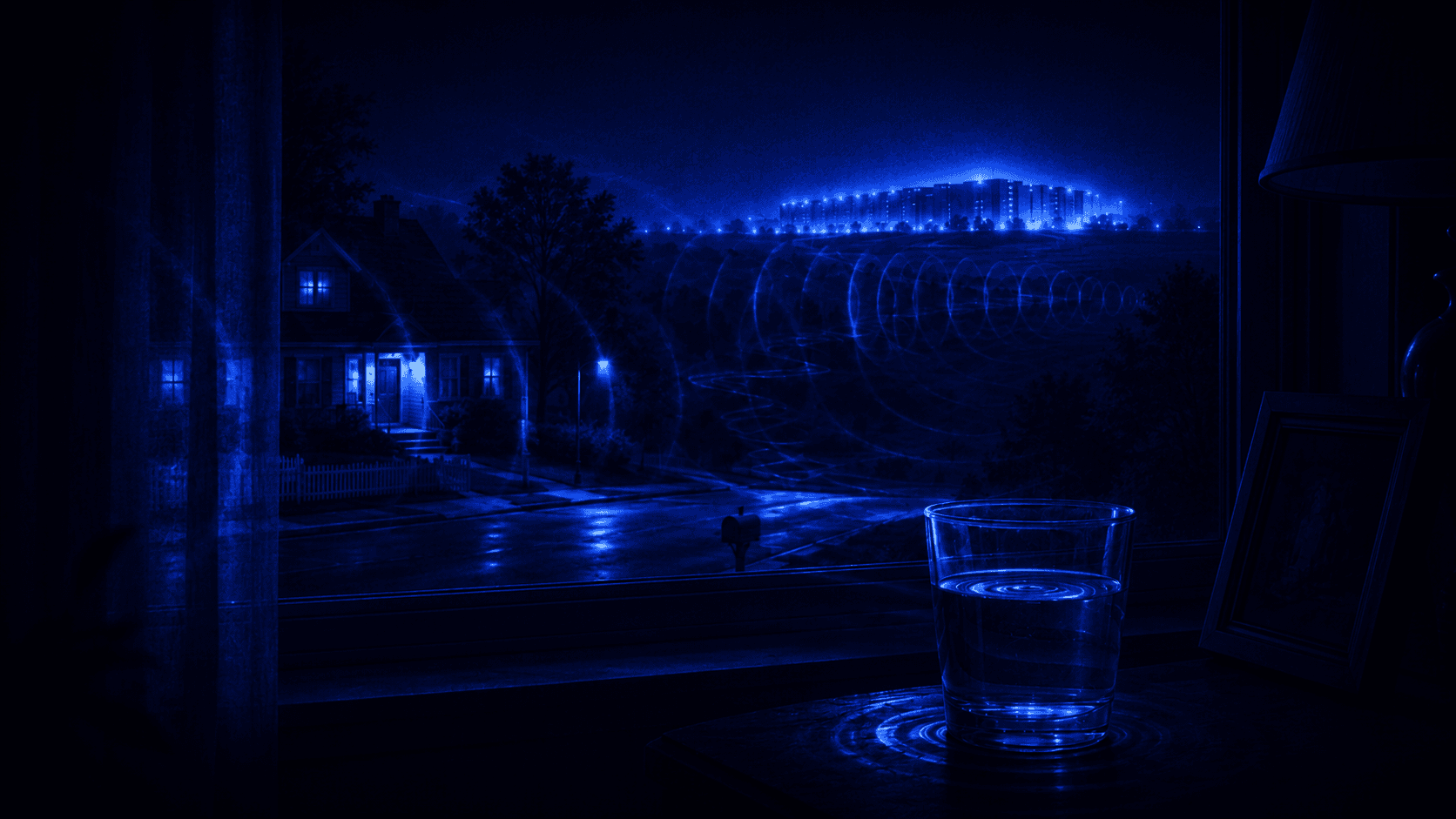
The complaints tend to begin with a sound. A low mechanical hum arrives when the cooling fans and backup generators spin up, and then it never quite leaves. In Mount Pleasant, Wisconsin, one man told a federal court he changed his shift at work because he could no longer sleep through it.
Outside Buffalo, in North Tonawanda, neighbors describe a droning vibration that passes through the walls of a street that used to be silent at night. In northern Mississippi, residents near an xAI site report headaches, nausea, and a ringing in the ears they cannot shake.
The hum is not loud the way a highway is loud. Much of it is low-frequency infrasound, the kind that slips beneath the decibel meters regulators rely on, which is part of why residents say their complaints get nowhere with the agencies that measure sound.
And when they go looking for a remedy, most of them do not reach for a new law written for artificial intelligence.
They reach for one of the oldest tools in the common law.
The oldest tool in the box
Nuisance is the legal name for an unreasonable interference with the use and enjoyment of your own land. It predates zoning, the environmental statutes, and the modern permit system by centuries.
It does not require a specific statute, a violated permit, or a named pollutant. It asks one question: whether what your neighbor is doing to your property is unreasonable. That generality is why the doctrine is useful here.
The AI build-out has placed large, always-on industrial facilities next to houses faster than local zoning adapted to them, and nuisance is the residual remedy that reaches harms the permitting process did not weigh.
The suits arriving this year sort neatly into three channels, one for each way a data center reaches across a property line and into a home.
What they hear
Noise is the most common complaint, and the most litigated. In Ostergaard v. Microsoft, three residents near Microsoft's Mount Pleasant campus allege that roughly a thousand homes within a mile and a half are washed in constant low-frequency sound from diesel generators and the chillers, cooling towers, and condenser fans that keep the servers from overheating.
In Demers v. Digi Power X, neighbors of a former crypto-mine turned AI-ready facility in North Tonawanda make the same complaint about the same kind of sound. In New Jersey, a resident living within a mile of a data center under construction has sued its operator, DataOne, and in Mississippi, a separate class of xAI's neighbors sues over the round-the-clock noise and vibration of the gas turbines that power its Colossus site.
The cases share an evidentiary wrinkle that makes them harder and more interesting than an ordinary noise complaint.
The most intrusive part of the sound is infrasound, below the frequencies that standard dBA meters weight heavily, so a facility can measure as compliant on paper while a bedroom two ridges away vibrates all night.
Proving that gap, that the legally measured noise and the physically felt noise are not the same thing, is where these cases will be won or lost.
What they breathe
The second channel is air, and its sharpest example is also the most politically charged. To power its Colossus data centers around Memphis, xAI installed dozens of methane gas turbines, and according to a suit brought by the NAACP and the Mississippi State Conference of the NAACP, it did so without the Clean Air Act permits the turbines require.
The plaintiffs allege the Southaven plant has the potential to emit more than 1,700 tons of smog-forming nitrogen oxides a year, along with fine particulate matter, carbon monoxide, and formaldehyde, a carcinogen.
The turbines sit beside historically Black communities, including the Boxtown neighborhood that fought an earlier round of turbines at Colossus 1, which gives the case an environmental-justice frame the noise suits lack.
This channel runs through a federal statute rather than the common law, and it has already drawn the federal government in on the company's side: the Department of Justice has intervened in the case.
But the underlying grievance is identical to the noise suits. A machine that has to run continuously is producing an externality that lands on the people who happen to live next to it, and they are asking a court to make it stop.
What they drink
The third channel is water, and it is the quietest of the three precisely because the harm is invisible until it reaches a tap.
In eastern Oregon, residents of the Lower Umatilla Basin allege that Amazon's data-center operations concentrated nitrate in already-stressed groundwater through evaporative cooling and disposal, and they plead it as a mix of the old and the new: a federal hazardous-waste claim under RCRA stacked on top of common-law private nuisance and trespass.
Amazon has since agreed to a settlement funding clean-water projects in the basin, without admitting wrongdoing. What connects it to the noise and air cases is the same underlying fact: cooling a data center is a physical process with a physical footprint, and that footprint does not stop at the fence.
Why the suits are arriving now
None of this is happening in isolation. It is the litigation tail of a much larger revolt. A Gallup survey this spring found that roughly seven in ten Americans oppose a data center being built in their area, a higher rejection rate than nuclear plants draw.
At least a dozen states have introduced data-center moratorium bills in 2026, with Maine the first to pass one into law, and organized local opposition has blocked or delayed more than $60 billion in projects in barely a year.
The lawsuits are what happens when the front end of that fight fails. States and towns spent the last several years competing to attract these campuses with tax incentives and expedited permitting, and the scrutiny that zoning would ordinarily apply got waved through. Nuisance litigation is the bill for that, arriving after the concrete is poured.
What the operators will say back
These are not easy cases, and the defense has real material. Nuisance is a balancing test, and the operators will argue that the social value of the facility, the jobs, the tax base, the computing capacity a modern economy runs on, weighs against a finding of unreasonableness.
They will point to mitigation already underway; Microsoft, for instance, says its engineers adjusted fan speeds and added sound-dampening and considers the issue resolved.
They will raise coming-to-the-nuisance where the industrial use predates the complaint, contest whether infrasound or a diffuse plume actually caused a given plaintiff's harm, and fight class certification on the ground that noise and exposure vary house by house. Each of these is a live argument, and some of these suits will not survive them.
Underneath the individual cases is a real conflict that will not resolve on its own. Data centers are designed to run continuously, and that is the point of them. Nuisance law exists to protect the ordinary use of a home from exactly that kind of steady, unconsented interference.
Courts now have to decide, one record at a time, how much of the AI build-out's physical burden the people nearest to it are expected to absorb.
For an industry that has treated siting as a settled, back-office question, that is a more open question than it planned for.
The next case is already forming.
For every operating data center there is a neighborhood nearby and a complaint that has not been filed yet.
Rain Intelligence maps where litigation is likely to land next, by operator, community, and theory, before the first plaintiff walks into a firm.
Book a demo to see it matched to your practice, clients, and jurisdictions.