The Map They Drew Themselves: Inside the Nest and Ring Bystander Facial-Recognition Class Actions
Google and Amazon disabled doorbell face scanning in a few states and left it on everywhere else. New suits argue that map is the case. Here's the theory.
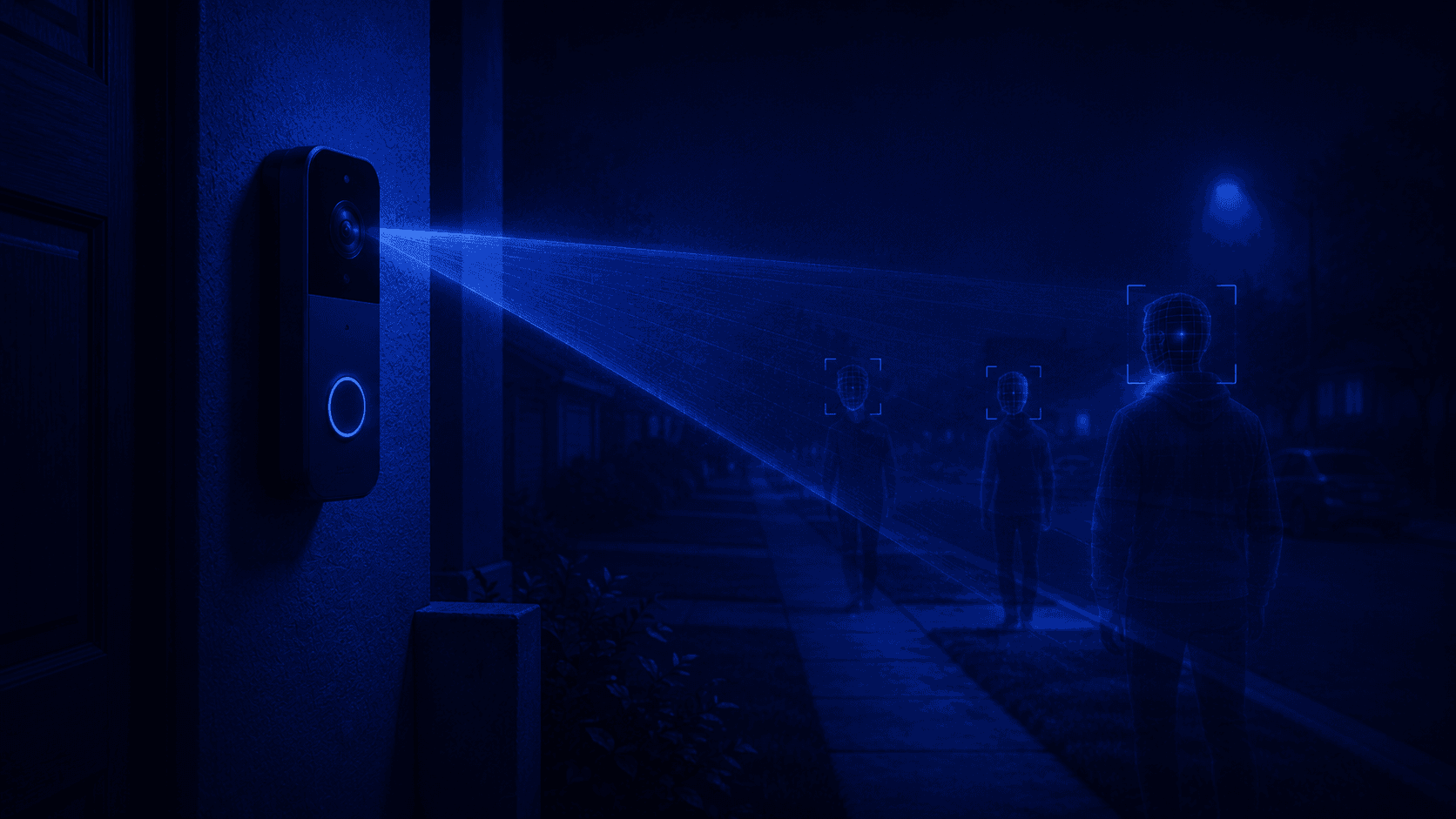
Google turns off Nest's Familiar Face Detection in Illinois. Amazon turns off Ring's version in Illinois, Texas, and Portland. Both companies leave the feature running everywhere else, including in front of the doorbells belonging to the neighbors of the eight Virginia residents who sued Google on June 29, 2026.
Three new class actions argue that this pattern, the short list of places where the feature is switched off, is the case. By choosing exactly where not to scan faces, the companies drew a map of where they believe the practice is unlawful, and the plaintiffs are now following it.
The suits are Fennessy v. Google and Trevino v. Google, both filed in the Northern District of California days apart, and Sigwalt v. Amazon, filed earlier in the Western District of Washington.
All three plead the same core theory: a doorbell running facial recognition scans every person who enters its view, generates a biometric faceprint, and files it against the owner's library, and it does this to people who never bought the device, opened an app, or agreed to anything.
The allegations are unproven and the defendants have not yet answered, but the theory is unusually well-constructed, because much of its evidence comes from the companies' own conduct.
The people who never agreed to it
Ring introduced Familiar Faces in December 2025, joining a similar feature that Nest cameras already offered.
To the buyer, the pitch is convenience: the camera learns to tell a spouse from a stranger and tailors its alerts. To make that work, the complaints allege, the device has to build a faceprint of everyone it sees, then compare each new passerby against the stored set.
One of the Google complaints describes a library that pairs facial geometry with non-biometric details like clothing and body size, so a person can be recognized even when the face is partly hidden.
The plaintiffs are not the people who bought the cameras. They are the people the cameras watch: neighbors, houseguests, children, delivery drivers, anyone who walks up a path or past a porch.
They never saw a consent screen because there is no consent screen for a bystander, and that is the vulnerability the cases are built around.
A device owner can agree to terms of service; the stranger whose face is measured on the sidewalk cannot, and never had the chance. It also defines a class of extraordinary size.
Ring and Nest cameras number in the tens of millions, and once the disabled states are set aside, the proposed class approaches everyone in the country who has walked into the view of one, which is part of what makes the theory, if it holds, so consequential.
The map
What turns a general privacy grievance into a targeted legal theory is where the feature is missing.
Google's own support documentation states that Familiar Face Detection is not available for cameras based in Illinois, citing state regulatory restrictions, and elsewhere advises owners, in the complaints' favorite line, to check your local privacy laws before saving face data.
Amazon told reporters that Ring's Familiar Faces would not run in Illinois, Texas, or Portland, Oregon.
Those are not random exclusions. They are precisely the jurisdictions where biometric capture without consent is most clearly and most dangerously regulated.
To the plaintiffs, a company that selectively disables a feature in three places has effectively published its own legal risk assessment.
The complaints read the disablement as an admission: the companies believe the conduct is unlawful where the statutes are explicit, and they have kept it running everywhere the statutes are silent or untested.
The engineering choice, one feature toggled off by geography, becomes the plaintiffs' central exhibit.
Why the cases route around BIPA
The obvious tool for a biometric case is the one the companies avoided: Illinois's Biometric Information Privacy Act, the only such statute in the country with a private right of action and fixed statutory damages, and the engine behind the $650 million Facebook and $100 million Google Photos settlements.
But BIPA is unavailable here for the simplest of reasons. The companies switched the feature off in Illinois, so there is no Illinois conduct to sue over. The plaintiffs have to go where the cameras still scan.
Texas is closed for a different reason. Its Capture or Use of Biometric Identifier Act is strict, but it has no private right of action, enforceable only by the attorney general.
That is why the biometric reckonings in Texas have taken the form of state settlements rather than class actions: $1.4 billion from Meta in 2024 and $1.375 billion from Google in 2025, the latter resolving claims tied to Google Photos, Assistant, and Nest. Portland's 2021 ban on private facial recognition in public accommodations covers the third disabled zone.
So the plaintiffs build their cases in the space the map leaves open, using statutes never written with biometric artificial intelligence in mind: Virginia's right-of-publicity law, its Computer Crimes Act, which lists biometric data as protected identifying information and carries its own civil remedy, the Virginia Consumer Protection Act, California's Civil Code Section 3344, the California constitution's privacy clause, common-law intrusion upon seclusion, and the state unfair-competition law.
Virginia is the recurring anchor by design: the named plaintiffs live there, the state has no BIPA-style consent law of its own, and its Computer Crimes Act is one of the few older statutes that already lists biometric data among the identifying information it protects, which makes it the most promising place to argue that a law written before the technology nonetheless reaches it.
The wager, in Virginia and California alike, is that the text of each statute covers the conduct even though its drafters never imagined a doorbell.
Knowledge is not a close question
Most privacy cases have to work to establish that the defendant knew its conduct was risky. These do not.
Google paid Texas $1.375 billion in 2025 to resolve biometric-collection claims that reached Nest by name, and then continued to run Familiar Face Detection in every state but Illinois.
A company that builds a feature with a per-state disablement switch, and flips that switch in exactly the jurisdictions with the sharpest biometric laws, has documented its own awareness in the product itself.
Whatever else the defendants dispute, they will have a hard time arguing they did not understand that scanning faces without consent carries legal exposure.
Why it is a genuinely hard case
Start with the precedent that is not here.
The closest analog to a bystander-biometric case is Clearview AI, which built a database of billions of faceprints by scraping images of people who never consented, a class that, like these, swept in strangers and non-users rather than customers.
But Clearview was litigated and settled under BIPA, the very statute these plaintiffs have left behind, and none of the three complaints so much as cites it.
That is the strategic bind in miniature: the one clear precedent for non-consensual faceprinting ran through Illinois law, and by choosing to sue where the feature still operates, these plaintiffs have set aside the authority that fits them best and taken on the burden of showing that untested statutes reach the same conduct.
The same feature that makes these suits interesting also makes them uncertain. None of the statutes the plaintiffs invoke was written for biometric AI, and the defendants will argue that the text does not stretch to cover it.
Right-of-publicity and Section 3344 claims traditionally require using a person's identity for commercial advantage, typically in advertising or endorsement, which is not obviously what a doorbell does when it sorts visitors for its owner.
The Virginia Computer Crimes Act was aimed at unauthorized access to computer systems, not at a homeowner's camera. Intrusion upon seclusion asks whether there is a reasonable expectation of privacy on a public sidewalk or a shared walkway, a question courts have answered inconsistently.
There are also the structural hurdles that follow any bystander theory: whether a person who never knew they were scanned has suffered the kind of concrete harm that supports standing, and how a nationwide class holds together when the governing law changes at every state line.
On the first question, the Google plaintiffs press an unusual wrinkle: they allege they cannot even discover which doorbells scanned them, while Google holds the records to know exactly where each faceprint was captured, an asymmetry they cast as part of the injury rather than an obstacle to proving it.
The novelty cuts in both directions. Because no statute fits cleanly, every count is to some degree a stretch, and a motion to dismiss could take several of them out.
But because the conduct is so uniform and so widespread, a single count that survives becomes a template that can be copied against every camera maker in every state where the feature still runs.
Everywhere Else Is the Class
The through-line is a kind of inversion. Google and Amazon drew a small map of caution, three jurisdictions where they decided the safest move was to turn the feature off.
The plaintiffs took that same map and read it as its negative: if those are the places the companies believe the conduct is unlawful, then every other state is a place where the companies chose to do it anyway, in front of people who could not consent.
Whether that inference becomes a winning legal theory depends on statutes that were built for other problems and on judges who have not yet decided how far the old words reach. But the shape of the fight is already clear.
If even one of these theories clears a motion to dismiss, the boundary the companies drew around three jurisdictions stops being a shield and becomes a directory of every place the next complaint can be filed, against tens of millions of cameras that are still watching.
We saw this one coming.
On June 3, 2026, twenty-six days before the first Nest complaint was filed, Rain Intelligence forecast this case, naming the defendant, the feature, the bystander-biometric theory, and the class.
That is the work: reading the signals a company leaves in plain sight and telling our clients where litigation lands next, so your firm reaches the client first.
Book a demo to see it matched to your practice, clients, and jurisdictions.